
India's Double Crown: Men's and Women's Titles at the Commonwealth Kabaddi Championship 2026
কমনওয়েলথ কাবাডি চ্যাম্পিয়নশিপ ২০২৬-এ পুরুষ ও নারী দুই বিভাগেই অপরাজিত চ্যাম্পিয়ন ভারত। পুরুষ ফাইনালে ভারত শ্রীলঙ্কাকে ৫৪–২০ এবং নারী ফাইনালে উগান্ডাকে ৩৫–১৫ পয়েন্টে হারায়। পুরুষদের দিকে আদিত্য শিন্ডে সুপার ১০ (১৪ রেইডে ১০ পয়েন্ট), ভারত হুডা ৮ রেইড পয়েন্ট নিয়ে একবারও ট্যাকল হননি, যোগেশ দহিয়া ৫ ট্যাকল পয়েন্ট। নারীদের দিকে সাক্ষী ৯, অনু সেন ৬, নিধি শর্মা ৫ ও রক্ষণে ঋতু মিথারওয়াল ও সুমন সাহু চারটি করে ট্যাকল পয়েন্ট নেন। গুরুত্বপূর্ণ প্রেক্ষাপট: এটি নবীন, কমনওয়েলথ-সদস্যনির্ভর আমন্ত্রণমূলক আসর, যেখানে ভারতের প্রধান প্রতিদ্বন্দ্বী ইরান কাঠামোগত কারণে অনুপস্থিত ছিল; তাই শিরোপাটি ব্র্যান্ডিং অর্জন, সর্বাঙ্গীণ আধিপত্যের প্রমাণ নয়। নারী ফাইনালের Statisticsে অভ্যন্তরীণ গাণিতিক অসঙ্গতি রয়েছে—দলগত রেইড পয়েন্ট ১০ বলা হলেও তিন খেলোয়াড়ের ব্যক্তিগত যোগফল ২০, যা যাচাই করা প্রয়োজন।
India has been crowned champion in both the men's and women's sections of the inaugural Commonwealth Kabaddi Championship 2026, finishing unbeaten. The men's final ended 54-20 against Sri Lanka; the women's final ended 35-15 against Uganda. Both finals were effectively one-sided, with neither opponent mounting a contest of comparable standard. It would, however, be a mistake to read the double title as proof of absolute Indian dominance, because the field did not include India's genuine rivals.
Where this competition actually sits
The 2026 Commonwealth Kabaddi Championship is a new, single-venue invitational. In the prestige hierarchy it ranks below the Asian Games and the Asian Championship, and is closer to a commercial or developmental invitational. The organisers framed India as the home team, and the report notes applause from fans at the Veer Savarkar Sports Complex, meaning the hosts enjoyed favourable conditions in both atmosphere and control. The Commonwealth branding imposes an obvious structural limit: countries outside the Commonwealth cannot enter, so Iran, the side that has most often challenged India's men, was necessarily absent. Bangladesh and South Korea were also missing from the list of participants.
A primer for readers new to the sport
Kabaddi is a contact team sport in which the attacking player, the raider, enters the opponent's half within a 30-second limit, touches a defender and returns to his or her own half to score. That action is a raid. The defending side scores a tackle point by stopping the raider inside their own half collectively. Throughout the raid the raider must chant kabaddi continuously; if the chant breaks, the raid is void. If an entire side is ruled out, the opponent earns two bonus points and the wiped-out team is fully revived, a rule that drives kabaddi's famous swings. A raid worth three or more points is a super raid; a tackle completed with three or fewer defenders on court is a super tackle and worth two points. Ten or more raid points by one raider in a match is a super 10. The bonus line is a marked line deep in the opponent's half, worth one point only when the defending side has six or more players on court. The scoring structure here is Standard Style, the rectangular-court international variant, not the rural Circle Style.

Men's final: India 54, Sri Lanka 20
The internal composition of India's score is clear. The team collected 30 raid points and 14 tackle points for 44, then added eight points from four all-outs to reach 52. The actual result was 54, leaving a two-point residual, plausibly from bonus points. Sri Lanka's arithmetic checks out exactly: 11 raid points plus nine tackle points for 20.
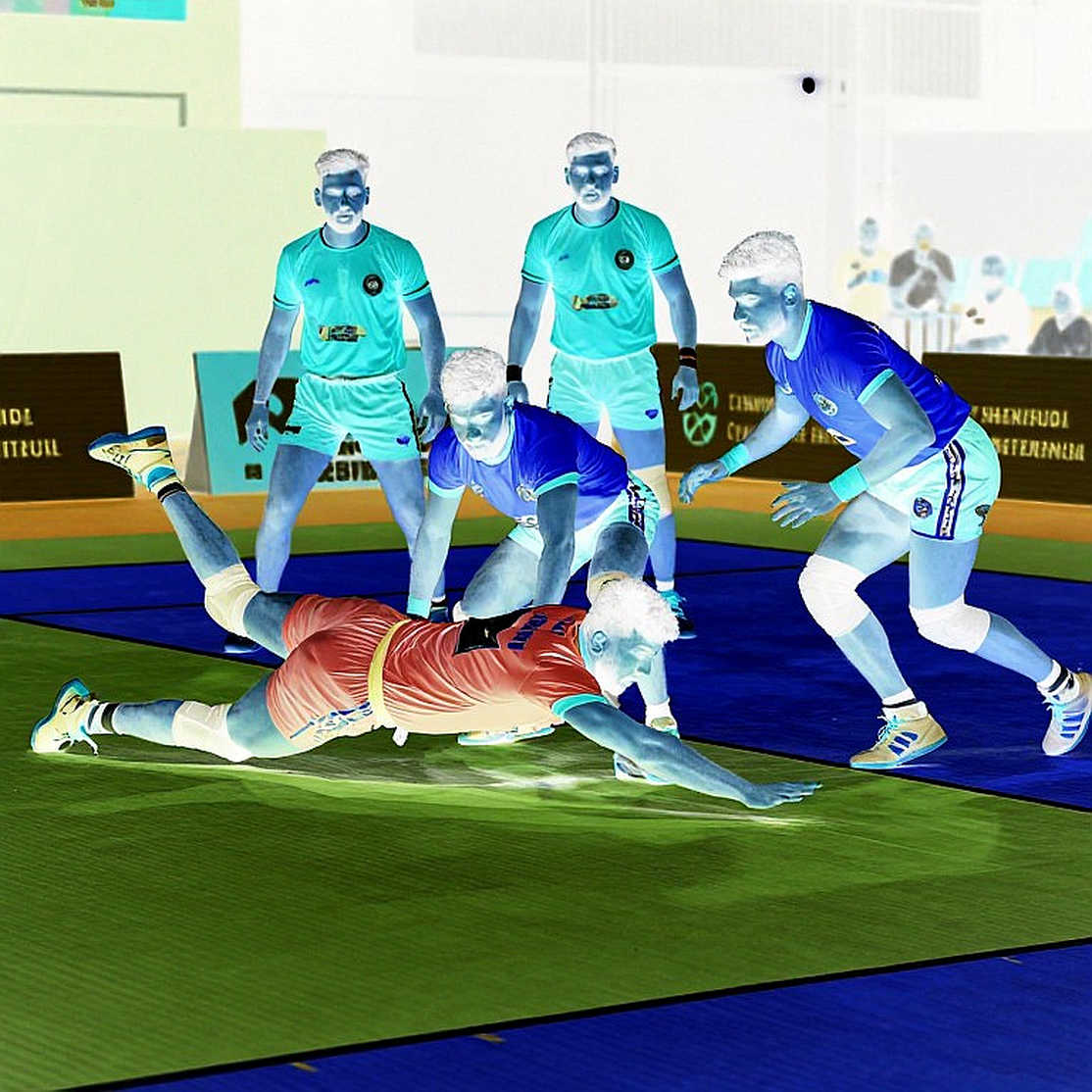
Aditya Shinde was the standout individual with a super 10, scoring 10 points from 14 raids, roughly 71 percent raid productivity. The elite professional benchmark sits around 55 to 65 percent, though this is a single-match, small-sample figure. Supporting raider Bharat Hooda scored eight raid points and was not tackled once all match, the most striking efficiency indicator in the report because it reflects decision discipline, not merely scoring. In defence Yogesh Dahiya led with five tackle points, with three others on two each; the team's 14 tackle points were spread rather than dependent on one star. Sri Lanka, by contrast, relied almost entirely on Maduwantha, the only one of their players above five points. One-dimensional dependence makes an opponent easy to plan against; India never faced that constraint.
Women's final: India 35, Uganda 15
In the women's final India forced two all-outs and led 20-14 on tackle points and 10-1 on raid points. Individually Sakshi scored nine, Anu Sen six and captain Nidhi Sharma five, forming a three-pronged attack; none reached a super 10. In defence Ritu Mitharwal and Suman Sahu took four tackle points each, giving the side a two-pillar spine. For Uganda, Nakayongo Shirat scored 11 of the team's 15 points while Uganda recorded only one raid point, which strongly suggests Shirat's points were tackle points, meaning she was a defender rather than the attacking load-bearer.
A serious numerical inconsistency that cannot be skipped
The women's data contains an internal arithmetic contradiction that this report flags explicitly. The article states India's raid points were only 10, yet lists Sakshi 9, Anu Sen 6 and Nidhi Sharma 5, which totals 20. If those individual figures are raid points, both statements cannot be true. Either the figure of 10 is wrong, or the player totals include tackle points. The inconsistency affects more than detail: if the match really was built on 10 raid points against 20 tackle points, it was a slow, physical, defence-first contest, which sits awkwardly with a 35-point blowout. The men's data cross-checks reasonably, so analysis there is more reliable.
The tactical headline: depth, not stardom
For both Indian teams the tactical message is depth. The men's 30 raid points were shared across several raiders and the women's 20 across three, so no single player had to carry the side. Both opponents, by contrast, were one-dimensional. The biggest limitation is the untested strength: the report offers no evidence of how this Indian side fares against disciplined chain-tackling, Iran-style defence, so any claim of tactical invincibility is unsupported. A reasonable inference is that the men's team may be India's second or developmental string, since top professional stars typically do not appear at a low-prestige inaugural event; if so, efficiency numbers against weak opposition are naturally inflated.
International landscape and cultural layer
The competitive map is unipolar: India at the top, Iran and Bangladesh in the challenger tier but absent here, and Sri Lanka, Uganda and other Commonwealth entrants in the catch-up tier. Remaining unbeaten in both sections is true but competitively soft. The report calls India the Asian champions, confirming continental titleholder status, but this event did not test that status against Asia's strongest field. Culturally, kabaddi claims roughly 4,000 years of South Asian heritage and has been repackaged here in the language of Commonwealth branding. Uganda's women reaching the final represents at least a small grassroots foothold in Africa, meaningful as a trend signal rather than as a competitive threat.
Limits and next steps
This title is best classified as a branding title, not a ranking statement. Three specific tests lie ahead: whether a second edition materialises; whether Iran, Bangladesh and South Korea enter in future, which alone would give the title competitive weight; and whether the event connects to a bid for kabaddi's inclusion in the Commonwealth Games. Until then, India's double crown is a real achievement, but an unfinished examination.