
The Deep Structure of Kabaddi: A Full Analysis of Rules, Tactics, League Economics and the International Hierarchy
কাবাডি কী এবং কেন এটি নিয়ম-নির্ভর খেলা? কাবাডি হলো সাতজন বনাম সাতজনের আক্রমণ-প্রতিরক্ষা খেলা, যেখানে একজন রেইডার ত্রিশ সেকেন্ডের মধ্যে প্রতিপক্ষের অর্ধে ঢুকে স্পর্শ করে ফিরে আসেন এবং পুরো সময় ধরে চিৎকার করতে হয়। মূল পয়েন্ট: স্পর্শ এক, বোনাস লাইন এক, ট্যাকল এক, সুপার ট্যাকল দুই, সুপার রেইড তিন বা বেশি, অল আউটে দুই অতিরিক্ত পয়েন্ট ও পুরো দল ফিরে আসে। ডু-অর-ডাই নিয়ম প প্রতিরক্ষা অসম্ভব করে দেয়, ফলে স্কোর দ্রুত বদলায় এবং কোনো লিড নিরাপদ থাকে না। স্ট্যান্ডার্ড স্টাইল (প্রো কাবাডি League, এশিয়ান Games) ও সার্কেল স্টাইল (গ্রামীণ পাঞ্জাব, পাকিস্তান) সম্পূর্ণ আলাদা — Statistics মেশানো যায় না। International স্তরক্রমে ভারত শীর্ষে, ইরান ২০১৮ জাকার্তা এশিয়ান Gamesে ভারতের স্বর্ণধারা ভেঙেছে, এরপর বাংলাদেশ, দক্ষিণ কোরিয়া ও পাকিস্তান। কাবাডি অলিম্পিক খেলা নয়; অংশগ্রহণকারী দেশের সংখ্যা, মহাদেশীয় বিস্তার ও নারী খেলার গভীরতা — এই তিনটি বাধাই প্রধান। বাণিজ্যিকভাবে League একক সম্প্রচারকারীর ওপর নির্ভরশীল এবং নিলামের দামকে কখনো খেলোয়াড়ের মানের প্রমাণ হিসেবে ধরা উচিত নয়; সঠিক মাপকাঠি সফল রেইডের শতাংশ, ডু-অর-ডাই রূপান্তর ও ট্যাকল সফলতার হার।
- Introduction: Reading Kabaddi Through Its Rules
The most common misconception about kabaddi is that it is a simple sport. Seven players against seven, one man crosses into the opponent's half, touches someone, returns, and a point is scored. Anyone who watches a match with that picture in mind will be confused within minutes. Every point in kabaddi emerges from a stack of rule filters — the rule of breath, the rule of time, the rule of the boundary, the rule of numbers. Because these four variables operate together, a kabaddi scoreboard cannot be read like a football or basketball scoreboard.
This report is not a match report and not a win-loss account of any team. It is a layer-by-layer analysis of the structure called kabaddi: what the rules are, how tactics are born directly out of those rules, how the professional league stands economically, what the international hierarchy looks like, where the cultural narrative is true and where it is exaggerated, how large the governance risk is, and where the media most reliably gets this sport wrong.
- The Raid: A One-Man Invasion With a Thirty-Second Limit
The basic unit of kabaddi is the raid. A designated attacker — the raider — must cross the centre line, enter the opponent's territory, touch one or more defenders, and return to his own half. All of this within thirty seconds. That limit is a hard boundary, not a guideline.
Alongside it sits the cant, the rule that separates kabaddi from almost every other sport on earth. Throughout the raid the raider must chant continuously — the sound from which the sport takes its name. The chant serves one purpose only: proving that the raider is not taking a breath. If the chant breaks for even an instant, the raid is dead on the spot. Kabaddi therefore contains a breath-activated timer that the entire stadium can hear, and the raider's physical capacity and mental composure are tested simultaneously while the audience witnesses the test directly.
A subtle but critical aspect is the return journey. Touching is not enough; the raider must get back. Failing to reach his own half under the pressure of a tackle hands the point to the opposition. In kabaddi, attack is never a safe investment; the raider personally controls the risk-reward ratio of every raid.

- Tackles, the Bonus Line and Super Tackles
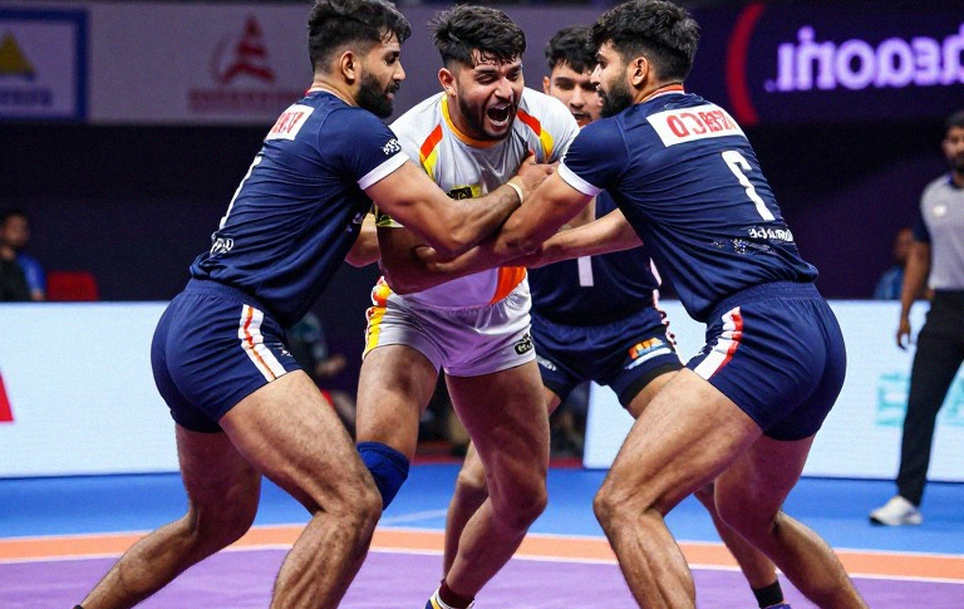
The defence has exactly one scoring weapon: the tackle. Seven defenders collectively stop the raider inside their own half — ankle hold, thigh hold, block, or a linked chain of players. Success earns one point. Defence in kabaddi is not passive; defence is a way to score. In the modern game the defensive base rests on three techniques: quick low footwork, low hooking, and coordinated angled blocks.
Then there is the bonus line. Crossing a line marked deep in the opponent's half, with the condition that the defence has six or more players on court, earns the raider an extra point. The rule is essentially a courage bonus — a structural mechanism to push raiders deeper into danger. The bonus line is what splits raiders into two types: those who go deep hunting big points, and those who touch and retreat on percentage. Judging a raider purely by total raid points understates his value; without bonus-line data, the true contribution is hidden.
There is also the super tackle. A tackle completed while the defence has three or fewer players on court is worth two points rather than one. This is a structural incentive handed to a depleted side. The same logic recurs throughout kabaddi's rule design: a team falling behind is not simply crushed; it is given a high-value opportunity.
- All Out and Do-or-Die: Two Big Structures
The most dramatic rule is the all out. If all seven players of a side are out, the opponent gets two bonus points and the entire side revives together. Six points go into one basket and seven players return to the court. Consider how large a swing that creates. In football a two-goal lead is usually comfortable; in kabaddi a six-point lead can dissolve in seconds. The scoring model is non-linear, and an analyst who reads a kabaddi scoreline with football eyes will systematically misjudge game control.
The second structure is do-or-die. A raid that produces no touch and no bonus-line crossing is an empty raid. After two consecutive empty raids, the third becomes do-or-die — if that also fails, the raider himself is out. The meaning is deep: a team cannot simply burn the clock. Passivity gradually turns into self-destruction. This is a major reason for kabaddi's scoring density; a forty-minute match produces more points than many invasion sports because the rules themselves force risk-taking.
Read together, these two rules reveal that kabaddi's design is partly a penalty system: teams that fall behind are given a route back, while teams that avoid risk are punished.
- The Scoring Model: Why No Lead Is Safe
The point list runs as follows: touch one point, bonus line one point, tackle one point, super tackle two, super raid three or more, all out two bonus points. A single raid can yield three or four points, and the next raid can bring six through an all out. Gaps do not grow linearly; they jump like stairs.
From this arises a fundamental tactical question: how should time be used? A leading side naturally wants to reduce risk, but the do-or-die rule limits that instinct. A trailing side wants aggressive raids, but must also restructure its defence. That tension is kabaddi's core strategic frame.
The second structural question is time management. A match is two twenty-minute halves with a break. The professional league includes timeouts and rolling substitutions, which makes substitution timing a genuine tactical lever, especially for raider rotation. International events, however, do not apply these league-specific mechanisms — a distinction the media routinely blurs.
- Standard Style versus Circle Style
Kabaddi carries a naming problem: two different games share one name. Standard Style is the rectangular-court, seven-a-side form used in the professional league and at the Asian Games. Circle Style is the circular-field, one-attacker-versus-one-defender form popular in rural Punjab tournaments and in Pakistan. Scoring details, match tempo and tactical logic differ materially.
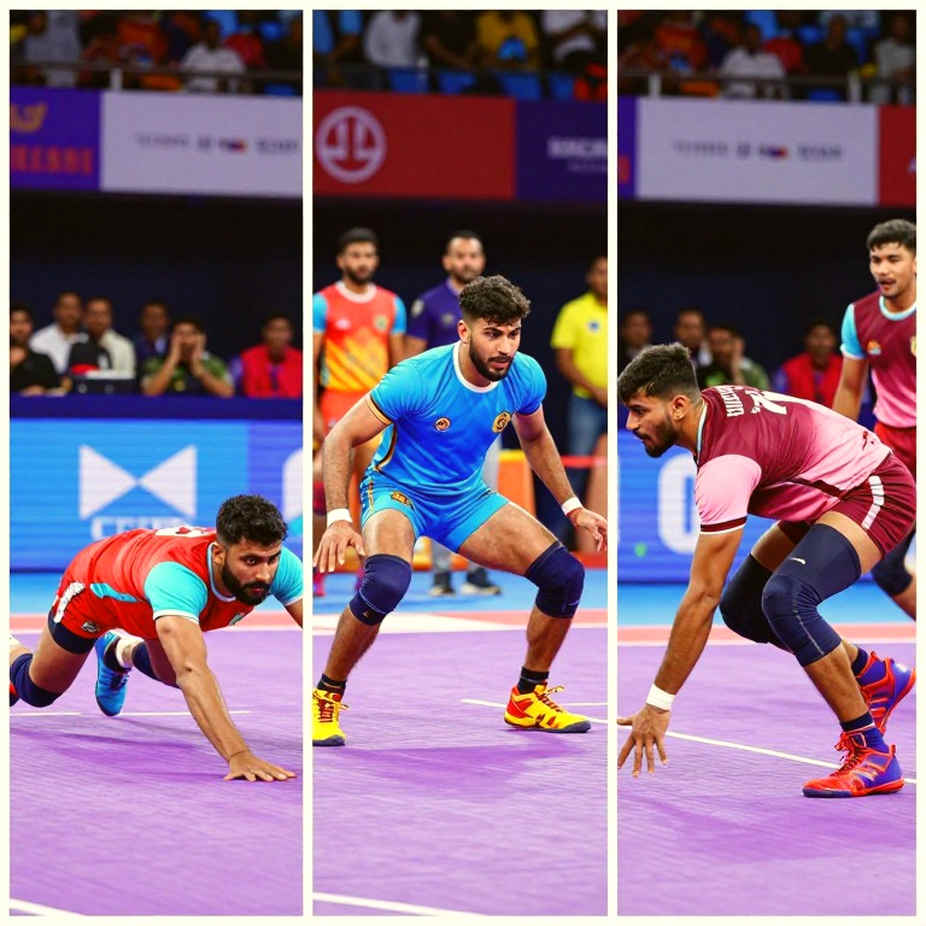
The distinction is decisive for analysis. Circle Style statistics cannot be used to evaluate a Standard Style player, and the prestige of the two tournament types cannot be treated as equal. Media coverage frequently omits the distinction, and a whole chain of downstream errors follows from that single omission.
Another dimension of the rules is the fixed structure of each raid — chant, time, boundary, return. Failure in any one of these four conditions means a failed raid. Technical skill and rule discipline therefore cannot be separated in kabaddi; even the most skilful raider loses the point if the chant breaks. This strictness makes the sport spectator-friendly, because the cost of error is immediate and visible.
- The Architecture of the Pro Kabaddi League
The Pro Kabaddi League launched in 2026 with eight franchises; the number later rose to twelve. The format combines franchise ownership, a player auction, entertainment-oriented presentation and regional-language commentary. It is not merely a tournament but a television product — and in the Indian context its significance is that the strongest available evidence for a non-cricket sport sustaining prime-time audiences comes largely from this league.
A structural feature of the model is vertical integration. League operations, broadcast rights and the platform tend to sit within the orbit of one large media group. The advantage is easy coordination of production and promotion; the risk is dependence on a single broadcaster. If the broadcast relationship breaks down or the broadcaster's strategy shifts, league visibility takes a direct hit.
The second structural weakness is the international market. The audience is essentially South Asian and diaspora South Asian. Overseas rights value remains very limited, which makes the revenue base geographically narrow — and that narrowness caps player salaries.
- The International Hierarchy
In Standard Style the international structure has three broad tiers. The first is India, long the monopolist. The second is Iran, the only side to have broken India's men's Asian Games gold run, with wrestling-derived physicality as its main advantage. The third comprises Bangladesh, South Korea, Pakistan and others.
Bangladesh's position is distinctive: kabaddi is the national sport, grassroots participation is enormous, but the professional layer is thin. That combination of huge popular base and weak professional structure makes Bangladesh an improbable but real potential power. South Korea has steadily raised its competitiveness through systematic training and league exposure. Pakistan's strength lies mainly in Circle Style, and India-Pakistan fixtures add a separate layer of nationalist emotional pressure.
To read this ladder correctly, one point must be held firm: dominance and popularity are not the same claim. India has been dominant in Standard Style for years, but the global participation base remains narrow. Merging those two claims into one is the most familiar structural error in kabaddi coverage.
- Jakarta 2026 and Its Meaning
At the 2026 Jakarta Asian Games, Iran won men's kabaddi gold and ended India's long streak. The significance goes beyond one result: it demonstrated that India's Standard Style dominance is not an inviolable law of nature — with systematic training, physical preparation and a clear tactical plan, the gap can be closed.
After that result a new note entered international kabaddi discussion: competitive balance. Caution is required, however. One gold medal does not mean the global competitive base has broadened. On the three measures that matter — number of participating countries, continental spread and depth of the women's game — kabaddi remains narrow. Iran's win should be read as evidence of possibility, not as proof of structural change.
Notably, Iran also began reshaping the women's competitive picture in the same period. That progress matters, because when measuring a sport's acceptability within the Olympic framework, the depth of the women's division is treated as a primary criterion.
- Cultural Background and the Mobility Pathway
Kabaddi's greatest asset and its greatest analytical trap are the same thing: its social narrative. The sport genuinely emerged from rural, mud-court, akhada-training traditions. Stories of a family's fortunes changing through kabaddi are real and verifiable as individual cases, supported by government job absorption, sports awards and public recognition.
But presenting that narrative as a trend is frequently exaggerated. One family's success does not mean the same path is open to thousands. Kabaddi's grassroots pipeline supplies cheap and highly motivated talent — a cost advantage for the league. The same pipeline caps urban middle-class sponsorship appeal and leaves players exposed to injury without a financial cushion.
The gender dimension matters here. A women's game exists with Asian Games status, but the top professional league has no separate women's competition. This is not a one-season problem but a structural pipeline risk, because without a professional career pathway it is hard to retain women athletes.
- India's Talent Geography
India's kabaddi talent map is fairly clear. Haryana is the centre of a power-based defensive tradition. Maharashtra is the birthplace of the modern rulebook and a hub of systematised coaching. Punjab is the heartland of Circle Style and the main carrier of cross-border cultural linkage. Uttar Pradesh and Tamil Nadu are raid-technique schools.
The tactical meaning of this diversity is real: Haryana players tend to be strongest in defence, Maharashtra players in structured raiding, Punjab players in aggressive risk-taking. Building a team therefore makes geographic mix itself a strategic decision.
- The Commercial Model and the Logic of the Auction
The commercial structure rests on three pillars: broadcast revenue, sponsorship, and franchise owner investment, with a player auction as the league's most visible market event. The auction is not merely a distribution mechanism; it is a media event in which the price itself becomes the story.
This is where the most important analytical test is required. An auction price is never a measure of quality; it is a signal of market expectation. The correct benchmark is the last two seasons of efficiency output — successful raid percentage, do-or-die conversion rate, tackle success percentage. Judging by total raid points alone is misleading, because playing more matches or attempting more raids inflates that number automatically.
Indian media shows a recurring tendency to present the headline price of a newly emerged star as proof of quality — a fame premium. Any auction story should therefore trigger one question: what evidence of efficiency stands behind that price?
- Governance and Institutional Risk
Several standing risks exist in kabaddi's institutional layer. At national federation level there is a history of election disputes and administrative turbulence, with periodic intervention by the national Olympic body or the sports ministry. Such instability can directly jeopardise national team participation, and it usually receives far less attention than on-field news.
Athlete protection matters too. Registration and transfer systems are less mature than cricket's, and post-retirement financial security is thin. Anti-doping structures exist but are less developed than in mainstream Olympic sports. Television review has arrived in the professional league, but officiating consistency in international Standard Style remains uneven.
The Olympic pathway is clearly closed. Kabaddi is not an Olympic sport and has not appeared on recent shortlists. The barriers sit in three places: number of participating countries, continental spread, and depth of the women's game. Realistic internationalisation is therefore regional and multi-sport-event based, not Olympic.
- The Risk Map
Kabaddi's risks can be layered. Competitive risk includes over-dependence on a single star raider, with concealed injury exposure alongside it. Commercial risk includes single-broadcaster dependence and the possibility that auction salaries outrun commercial returns. Institutional risk includes federation turbulence. Public-opinion risk includes the intensity of nationalist sentiment around India-Pakistan fixtures.
The least discussed but most dangerous is analytical-process risk, which is also extremely common. When a rule-based framework is built with many cells and many tables, the pressure to fill those cells becomes intense. Plausible-sounding but unfounded material slips in and is then read as findings. This is precisely why the first question in any kabaddi analysis should be: how much verifiable information is actually here, and how much is template-filling?
- Five Recurring Media Errors
First, conflating the styles. Treating Standard and Circle Style as comparable makes international comparison meaningless. Second, prestige inflation: treating an invitational or regional tournament as equivalent to an Asian Games medal event. The fix is simple — record the sanctioning body.
Third, presenting total points as efficiency. Volume statistics inflate easily in kabaddi, so evaluation without percentages is incomplete. Fourth, treating a hype narrative as a trend. Many players have been declared the next big star after one strong tournament, and the historical hit rate of those predictions is very low. Fifth, ignoring single-broadcaster dependence and federation fragility, because they are less visible than results but far more durable in impact.
- Conclusion: Understanding the Structure Is the Analysis
The best kabaddi journalism is not about names but about structures. Who scored how many points is the story of one match. Why those points were possible — which rule, which formation, which financial reality sat behind them — is the story of the sport. The first takes no time to write; the second requires understanding.
The core argument of this report is this: every shock in kabaddi — the six points of an all out, the compulsion of do-or-die, the doubled value of a super tackle, the temptation of the bonus line — is the deliberate product of rule design, not chance. An analyst who knows the design does not gasp at the match; he anticipates where the momentum can turn. One who does not know it sees the surprise but cannot explain the cause.
Kabaddi's future therefore depends on two things: broadening the base of global participation and keeping the professional league's financial foundation sustainable. The on-field drama is exciting on its own; what is needed is a structure in which the best athletes can choose the sport as a career.