
HomeKabaddiThe Name That Isn't on the List: Ritu Negi, Kabaddi's Mud, and a Silent Rs 1 Crore Decision
Kabaddi
The Name That Isn't on the List: Ritu Negi, Kabaddi's Mud, and a Silent Rs 1 Crore Decision
প্রশ্ন: হিমাচল প্রদেশের এশিয়ান Games নগদ পুরস্কার তালিকা থেকে কেন রিতু নেগি বাদ পড়েছেন? মূল উত্তর: রিতু নেগি, আর্জুন পুরস্কারপ্রাপ্ত ও ভারতীয় কাবাডি দলের প্রাক্তন অধিনায়ক, হিমাচল প্রদেশের এশিয়ান Games নগদ পুরস্কার তালিকা থেকে বাদ পড়েছেন। কারণ সরকারিভাবে স্পষ্ট নয়; ক্রীড়ামন্ত্রী ফাইল পর্যালোচনার প্রতিশ্রুতি দিয়েছেন। বাদ পড়ার সম্ভাব্য কারণ ডোমিসাইল বা বাসস্থান-সংক্রান্ত নিয়ম, যেখানে হরিয়ানায় বিবাহিত মহিলা খেলোয়াড় যোগ্যতা হারাতে পারেন। মূল তথ্য: - রিতু নেগি তিনটি এশিয়ান Gamesে দুটি সোনা ও একটি রুপো জিতেছেন এবং প্রাক্তন জাতীয় অধিনায়ক। - হিমাচল পুষ্পা রানা, জ্যোতি ঠাকুর ও ভাবনা ঠাকুরকে এক কোটি টাকা করে ঘোষণা করেছে; রিতু নেগি তালিকায় নেই। - রিতু নেগি ইন্ডিয়ান রেলওয়েতে কর্মরত এবং হরিয়ানায় বিবাহিত, তবে হিমাচলের প্রতিনিধিত্ব করেছেন। - ২০২৩ এশিয়ান Gamesের পরেও তিনি হিমাচল পুরস্কার পেয়েছিলেন, যা একটি নজির। - ২০২৬ সালের এশিয়ান Games অনুষ্ঠিত হয় জাপানের আইচি-নাগোয়ায়; কাবাডি অলিম্পিক ক্রীড়া নয়। সূত্র: মূল প্রতিবেদন, অক্টোবর ২০২৬। ক্রীড়া প্রশাসনিক নথি এবং পারিবারিক বক্তব্য অনুসারে। সম্পর্কিত প্রশ্নোত্তর: প্রশ্ন: রিতু নেগি কি পুরস্কার ফিরে পেতে পারেন? উত্তর: রাজনৈতিক চাপে ফাইল-পর্যালোচনার মাধ্যমে ফিরে পাওয়ার সম্ভাবনা বেশি, তবে নিশ্চিত ফলাফল এখনও ঘোষিত হয়নি। প্রশ্ন: এই ঘটনা কেন কাঠামোগতভাবে গুরুত্বপূর্ণ? উত্তর: এটি ডোমিসাইল ও Gender-সংক্রান্ত অসাম্যের দিকে ইঙ্গিত করে, যা বিবাহিত মহিলা খেলোয়াড়দের জন্য একটি বড় ঝুঁকি। প্রশ্ন: কাবাডি খেলোয়াড়দের জন্য প্রধান স্বীকৃতির ব্যবস্থা কী? উত্তর: রাজ্য নগদ পুরস্কার ও সরকারি চাকরি, কারণ কাবাডির জন্য কোনো অলিম্পিক পথ বা মহিলাদের পিকেএল নেই।
The list from Himachal Pradesh's sports department appeared on an October morning. Three names — Pushpa Rana, Jyoti Thakur, Bhawna Thakur. One crore rupees each. The state's announcement for three kabaddi players who won gold at the Asian Games in Aichi-Nagoya, Japan. And the fourth name that should have been on that list, the one the state's sporting circles had been discussing for days — it was not there. Ritu Negi was not there.
An Arjuna Awardee. Former captain of the Indian kabaddi team. Three Asian Games, two golds, one silver. A member of the same gold-winning squad. Yet her name is missing. Same field, same gold, same state identity — and still the list did not recognise her. The uproar this exclusion has created over the past two days, across both Himachal's politics and its sports administration, has raised one question: whom does a state claim as its own, and whom does it not?
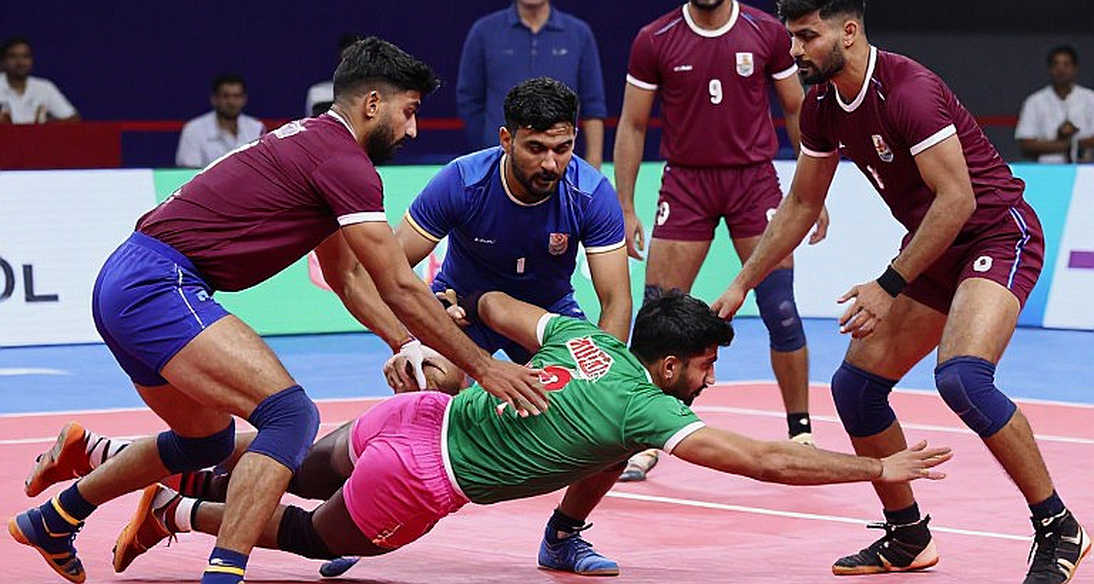
To understand kabaddi, one thing must be clear first. It is a contact team sport in which one raider from the attacking side enters the opponent's half, tries to touch defenders and return to his or her own half — and throughout that entire effort must chant 'kabaddi kabaddi' continuously, as proof of not inhaling. The Asian Games and the Pro Kabaddi League (PKL) are played on a rectangular court, called Standard Style — 13 metres by 10 metres. Rural Punjab plays a circular variant, Circle Style. This article concerns Standard Style only.
Kabaddi has been a medal sport at the Asian Games since 2026 for men and since 2026 for women. It is not an Olympic sport. That is the key to the economics at the centre of this entire affair. With the Olympic door closed, the Asian Games is the highest stage available to kabaddi's national teams, and winning gold there is the single biggest sporting achievement a state government can claim. That is exactly why an Asian Games gold triggers a one-crore cash award.
The Asian Games referenced here is the 2026 edition in Aichi-Nagoya, Japan — where India's women's kabaddi team won gold. India holds a near-monopoly on women's kabaddi; Iran is its main challenger. Bangladesh, South Korea, Chinese Taipei and Thailand sit a tier below. Himachal's award list is therefore rewarding members of a dominant squad. The question is not about competitive merit — it is about which state claims the athlete as its own.
And that claim is where the complexity lies. Indian states claim athletes not by birth but by domicile or residence and representation in domestic competition. Marriage can shift an athlete's administrative 'home state' — and that is precisely the knot in this dispute.
From years of watching kabaddi matches, I can say the sport's beauty lives in micro-margins — a half-second hesitation at the raid line, a toe drag, a breathing rhythm. But Ritu Negi's case is not a story of the field. It is a story of a file. Yet its weight is no less, because that file decides what a body's labour on the field will earn.
First, Ritu Negi's career in numbers. Three Asian Games, two golds, one silver. The Arjuna Award. Former national captaincy. This record makes clear this is not a newly emerged talent — this is a long-serving, established, top-tier athlete. Her span of three Asian Games suggests roughly ten to twelve years at the international level. She is in the late stage of her career. In her own words, an exclusion 'at this stage of my career' is 'deeply insulting'.
But the real fact lies one layer below. From the same gold-winning squad, Pushpa Rana, Jyoti Thakur and Bhawna Thakur — three Himachal players — received the award. Ritu Negi did not. Four members of one squad, one gold, and one excluded. The meaning is plain: the exclusion is administrative, not merit-based. And an administrative decision implies a rule — one that has either changed or gone unnoticed.
What is that rule? The most likely answer concerns domicile or residence. Ritu Negi is employed by Indian Railways — a familiar livelihood pathway for Indian athletes. But she has stated clearly that in domestic competition she consistently represented Himachal, not Haryana. She married in Haryana. Put together, these two facts produce a picture: a residence-based rule under which a woman athlete who moves to another state through marriage can lose her 'native state' award eligibility.
This is where the most important piece of the episode emerges, and it comes from her father's account. He has stated that after the 2026 Asian Games, Ritu received a Himachal award — despite being married in Haryana. In other words, a precedent once existed in which marriage was no barrier. The 2026 list denies that precedent. The questions follow: when did the rule change? Who changed it? And if it changed, were the athletes told beforehand?
The answers to these questions are the true weight of this episode. In sports administration, when a rule becomes unclear or is silently altered, the greatest damage is to trust. An athlete makes career decisions on the basis of a promise — that a specific achievement will bring a specific recognition. If that promise rewrites its own rule every year, the incentive's very purpose collapses.
And note how opaque this decision has been. The Sports Minister himself has said he does not know the reason and has promised to review the file. When a state's sports minister does not know why an Arjuna Awardee and former captain has been dropped from an award list, it is clear the decision was not made on any clear, written, communicated criterion.
This is not a match story. There is no raid efficiency here, no tackle count. There is a file, a list, and a missing name. Yet the weight is real — because this list decides whether one crore rupees reaches an athlete who rose from a rural background. In a state like Himachal, where sporting talent comes largely from a mid-tier grassroots base, one crore rupees (about 10 million rupees, roughly 120,000 US dollars) is a life-altering sum. If the certainty of that money is itself uncertain, the motivation does not hold.
One thing needs clarifying here, because an Asian Games gold and a Railways job are two separate systems. Railways, police, the army — through these government jobs Indian athletes gain stable livelihoods. But those jobs do not determine which state claims them for awards. Ritu Negi's case shows exactly this fracture: her employment sits under a central institution, but her award eligibility is set by state rules. The two systems do not align.
One more point belongs here, true for every athlete who rises from kabaddi's soil. The sport is a South Asian rural inheritance — in northern India, the mud akhada, where bodies are built from childhood. Ritu Negi's career began exactly there. It started in a Himachal mud akhada, long before the Aichi-Nagoya podium noticed. That first chapter matters because that unnoticed, undiscussed time is the real story. And a state award system's job was to honour that time in the end. The list failed to do so.
To treat this episode as merely an isolated administrative error would miss the larger picture. Two forces are at work here, one visible and one quiet.
The visible one is politics. Ritu Negi was congratulated by the Chief Minister, former Chief Minister Jairam Thakur and MP Anurag Thakur. The latter two are associated with the opposition. The current government is Congress. Support for one athlete is thus taking on an openly political colour. This politicisation can harm in two ways: it turns an athlete-welfare question into a partisan fight; and it can accelerate a resolution, but if that resolution covers only this one case, the opacity of the rule remains.
The quiet one is the link between gender and domicile. In India's sports-award system this is a familiar structural inequity — married women athletes are especially exposed. A woman who marries into another state can lose her 'native state' award eligibility even after representing that state in domestic competition. The pattern of Ritu Negi's exclusion matches this structure exactly. The urgent question is not only 'will she get the one crore back' — but 'will the rule become marriage-neutral, or will only this one person be made an exception'.
Add to this kabaddi's own professionalisation gap. The Pro Kabaddi League has no women's league. There is no Olympic pathway. State awards and government jobs are, in effect, the primary recognition mechanisms for these athletes. When these two systems do not align, and when the rules are opaque, the system fails at its most basic task — holding athletes' trust.
The phrase 'daughter of Himachal' also deserves attention. In Indian sports discourse it is a familiar emotional device — an appeal to state identity and familial belonging. But this same device raises a question: if Ritu truly is a 'daughter of Himachal', why did the list not recognise her? Language and rule stand against each other here.
A comparison is relevant here, though not for praise. In Bangladesh, too, the same questions arise around state sports awards — who counts as 'our' athlete and who does not. In both systems the core problem is identical: the criteria are not written down, so the final decision often rests on personal discretion. The difference is only that in one system the path to complaint is wide, and in the other it often is not.
The Sports Minister's promised file review is now the most important turning point. One likely outcome is that, under political pressure, Ritu Negi is reinstated and given the one crore rupees. But that is not the real test. The real test is whether the review produces a published, written, marriage-neutral eligibility criterion.
If the resolution covers only this one case, it will not become a precedent for other Indian states. But if the criterion becomes clear and marriage-neutral, Ritu Negi's exclusion — so far a personal humiliation for one woman athlete — may in the future become a protection for many more. The question is not about a list; it is about a rule.
Related Players
Recommended
The Missing Crore: A Himachal Kabaddi List and the Unspoken Rule of Marriage and Domicile2026-10-10
The One-Crore List: Ritu Negi's Exclusion and the Question of a Woman's Address in Kabaddi2026-10-10
Asian Games 2026 Kabaddi: The Invisible Opponent Called Score Difference, and a Semi-final Stolen From Bangladesh2026-09-26
Recommended
Fourteen Points at Half-Time: The Real Picture of Women's Kabaddi Is Not in the 48-24 Scoreline2026-09-26
Asian Games 2026 Kabaddi: Bangladesh and Thailand — The Same Number, Opposite Stories2026-09-26
Seventy-Five Minutes Between Two Whistles: The Asian Games 2026 Kabaddi Semifinals and the Question Nobody Is Asking2026-09-25
Women's Kabaddi at the Asian Games: Four Finalists in Five Editions, and One Unverified Gold2026-09-28
The Bonus-Line Leak: Inside India's 48–25 Win at the 2026 Asian Games2026-10-05