
HomeAsian CricketPakistan lift Plate title at Hong Kong Sixes, but their title defence ends in fifth place
Asian Cricket
Pakistan lift Plate title at Hong Kong Sixes, but their title defence ends in fifth place
হংকং সিক্সেসে প্লেট শিরোনাম জিতেছে পাকিস্তান, ফাইনালে ওমানকে ১৮ রানে হারিয়ে। ছয় ওভারে ৪ উইকেটে ১৫৪ রান তোলে পাকিস্তান, জবাবে ওমান করে ১৩৬/৪। আব্বাস আফ্রিদি ১৬ বলে ৭৩ রান করেন (১১ ছক্কা), ওমানের পক্ষে উসমান আলী ৬৭ ও জোহাইব আমানত ৬১ রান করেন। তবে পাকিস্তান গ্রুপ পর্বে আমিরাতের কাছে হারের পর পঞ্চম স্থানে শেষ করে, শিরোনাম রক্ষায় ব্যর্থ হয়। প্রতিবেদনের তথ্যে অসঙ্গতি আছে—আমানতের ৬১ রান তাঁর চার-ছক্কার হিসাবের সঙ্গে মেলে না, আর পাকিস্তানের ব্যক্তিগত রানের যোগফল ১৪৪, দলীয় স্কোর ১৫৪। এছাড়া চ্যাম্পিয়নশিপ ফাইনালের বিজয়ী, Bowling Statistics ও উদ্ধৃতি কোথাও নেই।
Pakistan have won the Plate title at the Hong Kong Sixes, beating Oman by 18 runs, but for a six-time champion side this is a consolation prize. Their title defence failed and they finished fifth. Having lost to the United Arab Emirates in Group C and finished second in the group, Pakistan were routed to the Plate bracket instead of the Championship knockout. The headline advertises a trophy; the reality is a campaign that ended far from the main prize.
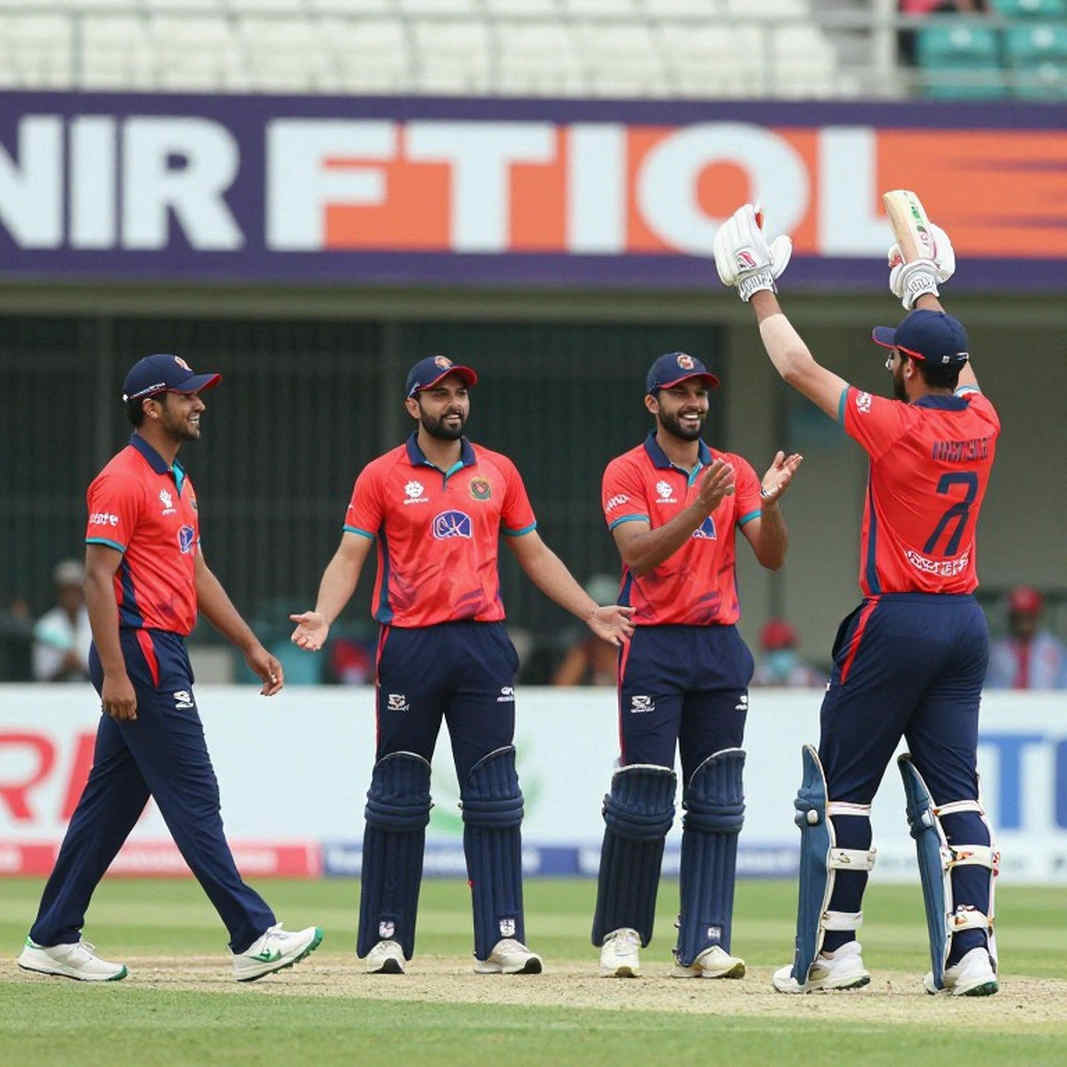
Batting first in the final, Pakistan made 154-4 in six overs. Captain Abbas Afridi was the centrepiece with 73 off 16 balls, including one four and eleven sixes, a strike rate close to 456. Abdul Samad (26 off 5, two fours and three sixes), Ahmed Daniyal (25 off 5, four sixes) and Muhammad Shahzad (13 off 4, two sixes) chipped in, while Khawaja Nafay made 7 and Irfan Niazi fell for a duck. Pakistan hit 21 sixes, and 89.6 per cent of their runs came in fours and sixes — in this format the innings is almost entirely boundary-dependent.
Oman replied with 136-4, falling 18 short. Their innings was almost entirely two men: Usman Ali 67 off 17 (four fours, eight sixes) and Zohaib Amanat 61 off 18 (four fours, eight sixes). Together they made 128 of the 136, or 94.1 per cent. The other four batters contributed eight runs between them and faced no more than a single ball. Oman's four wickets read as one run out, Aamir Kaleem, plus three retired out — Sami Hassan, Shafiq Jan and Muzahir Khan. Oman needed 19 off the last over with two set batters at the crease, but that over is never described: no dot-ball count, no wicket, no explanation of how the chase collapsed.
The arithmetic explains the defeat better than the report does. A target of 155 in 36 balls requires 4.31 runs per ball; Oman managed 3.78. Usman and Amanat both passed 60 but scored their 128 off 35 balls, a rate of 3.66 — below the requirement. The problem was that the two set batters never got out, so the bottom four never batted. The loss was as much about the pace of the top two as about the last over.
The data in the report does not survive checking. First, Amanat is credited with 61, but his stated breakdown of four fours and eight sixes adds up to 64; a batter cannot score fewer runs than his boundaries. That breakdown is byte-identical to Usman Ali's, the signature of a duplicated line. The likeliest correction is the score, at 64, or a seven-six breakdown. Second, Pakistan's six individual scores sum to 144 against a team total of 154-4. Ten extras cannot be reconciled when the six batters faced only 34 of 36 deliveries, leaving at most two wides or no-balls; that implies roughly eight byes or leg-byes in a six-over innings, which is implausible.
A similar gap appears in the Plate semi-final against Hong Kong, which Pakistan won by ten wickets, chasing 107 without loss. Abbas was unbeaten on 55 off 13 with three fours and seven sixes, but the other opener is never named even though the arithmetic requires roughly 50 from him. Three of Pakistan's four wickets in the final are similarly unexplained; only Niazi's duck is described.
In the group stage Pakistan opened with a defeat to the UAE, for whom captain Khalid Shah made 71 off 20 with three fours and nine sixes. Pakistan then beat India, who made 88-5: Abbas finished unbeaten on 35 off 8 with a four and five sixes, and Nafay made 41 off 12. The UAE finished with two wins, Pakistan one and India none, which sent Pakistan to the Plate.
Abbas's tournament aggregate is the story of the campaign: 216 runs off 50 balls across four innings, a strike rate of 432, with 31 sixes and six fours. Sixty-two per cent of the balls he faced went for six. He was never reported dismissed — two explicit not-outs, one retirement and one unspecified — and in the final he made roughly half his side's runs.
The omissions matter. The single biggest fact of a tournament wrap-up — who won the Championship final — never appears. There are no bowling figures, no wicket-taking detail, no quotations, no toss and no player of the match. The 'six-time champions' line is undated. The venue is given as Mission Road Ground, Mong Kok, but the traditional Hong Kong Sixes venue is Tin Kwong Road Recreation Ground, so it needs verification, as does the year, 2026.
Structurally, the piece ends on a semi-final rather than the final, so the trophy moment is lost. The real drama — Oman needing 19 off the last over with two set batters — is never narrated, which turns the final into a scorecard rather than a story. And the true headline should have been the failed defence and the fifth-place finish, with the Plate only the resolution.
Related Players
Recommended
Krishna's Hamstring Blow: Aqib Nabi Enters India's ODI Squad for the New Zealand Tour2026-10-31
The Scorebook Written in the Half-Space: From Dot-Ball Clusters to Death-Over Geometry2026-09-26
Install a Bowling Machine: Chahal's Ranchi Remark and the Quiet Crisis of T20 Bowling2026-10-11
The Khulna Under-19 Notebook: Which Numbers Identify Talent, and Which Numbers Lie2026-09-29
The 43-Ball Storm and the 37-Ball Silence: What Abhishek's 113 Explains and What It Buries2026-10-27
Recommended
Lyon Dropped, Boland Strikes Twice: Auditing Australia's Selection Ledger on a Damp Gqeberha Pitch2026-10-20
Incomplete Input — Report Cannot Be Generated2026-11-01
Litton's Hip, Mehidy's Fever: Two Separate Ledgers Opened at the Toss for Bangladesh2026-10-17
The Empty Data Room and the Noisy Market: Why Cricket Analysis in the Transfer Window Begins With Verification2026-10-17