
Jemimah's 'life update' on the anniversary of a World Cup knock — with not one word of cricket in it
জেমিমা রদ্রিগেজ একটি ‘লাইফ আপডেট’ প্রকাশ্যে জানিয়েছেন, যা তাঁর অস্ট্রেলিয়ার বিপক্ষে একটি বিশ্বকাপ নকআউট Inningsের বার্ষিকীতে প্রকাশ পেয়েছে। তাঁর একমাত্র উদ্ধৃতি ‘কান্ট ওয়েট’। প্রতিবেদনটিতে ওই Inningsের স্কোর, তারিখ, মাঠ, Format (টি২০ না ওয়ানডে) বা ম্যাচের ফলাফল — কোনোটিই উল্লেখ করা হয়নি, এবং উৎসও নামানো হয়নি। ফলে এটি একটি কৌতূহল-নির্ভর সেলিব্রিটি আইটেম, ক্রীড়া-বিশ্লেষণ নয়। যে Inningsটিকে ‘বিখ্যাত’ বলা হচ্ছে, তা সম্ভবত ২০২৩ নারী টি২০ বিশ্বকাপের সেমিফাইনাল, তবে এটি যাচাই-সাপেক্ষ। মূল তাৎপর্য: নারী ক্রিকেটের কভারেজে ব্যক্তিত্ব-নির্ভর কনটেন্ট পারফরম্যান্স-বিশ্লেষণের চেয়ে অগ্রাধিকার পাচ্ছে, যা দীর্ঘমেয়াদে দর্শকভিত্তি ও সম্প্রচার-মূল্যের জন্য ঝুঁকি।
India women's middle-order batter Jemimah Rodrigues has publicly shared what is being described as a 'life update'. The interesting part of the item is its timing: it lands exactly on the anniversary of a World Cup knockout innings of hers against Australia. The headline calls that innings 'famous', and the only words attributed to the player are four: 'Can't wait'. That is the entire substance of the item.
So what cricket news is actually here? Short answer: none. No match has been played, no series announced, no squad named, no statistic supplied, no venue or date given. The innings whose anniversary anchors the whole piece — its score, its over count, its ground, the opposition's total, and its eventual outcome — appears nowhere. This is not a sports report. It is an anniversary-frame celebrity item in which cricket functions purely as a hook.
What is said, and what is not
Separating the two is the first task. Three things are stated: that Rodrigues has given a 'life update'; that it arrived on the anniversary of a World Cup knockout innings against Australia; and that her sole quotation runs to four words with no cricketing meaning.
Far more is absent: the nature of the update — personal, family, professional or commercial; where it first appeared — the player's own social channels, a press conference, or a board release; the date of publication; and, most importantly, which innings is being commemorated — which format, which tournament, which stage, and what the result was.
The item names no source, carries no direct quotation beyond four words, and gives no date. The summary line is a verbatim repeat of the headline. The basic verification chain is missing — and that is the most telling feature of the item, because it is not an isolated lapse. It is a specimen of a production model.

Ambiguity over which innings
The phrase 'famous World Cup knockout against Australia' points most naturally, in recent Indian women's cricket history, to the 2026 ICC Women's T20 World Cup semi-final in Cape Town, where a short, aggressive innings from Rodrigues narrowly failed to complete a chase. Indian media most often labels that innings her signature World Cup knock.
A second candidate exists: a league-stage meeting between India and Australia at the 2026 Women's ODI World Cup on home soil. The headline's word 'knockout' makes the second less likely, but the underlying text never fixes the format. Which innings the word 'famous' refers to therefore cannot be determined from this source.
That ambiguity matters, because a report that cannot identify its own subject carries no informational value for the reader. What the reader retains, at the end, is a name, an opposition, a calendar day, and one evaluative word. And whose evaluation is 'famous'? The headline writer's — not a selector's, not a data source's.
A further inference belongs in the bracket marked unverified: a knockout innings that attracts this kind of anniversary framing in Indian women's cricket is very often a brave chase that fell short rather than a trophy-winning knock. That is circumstantial, not established.
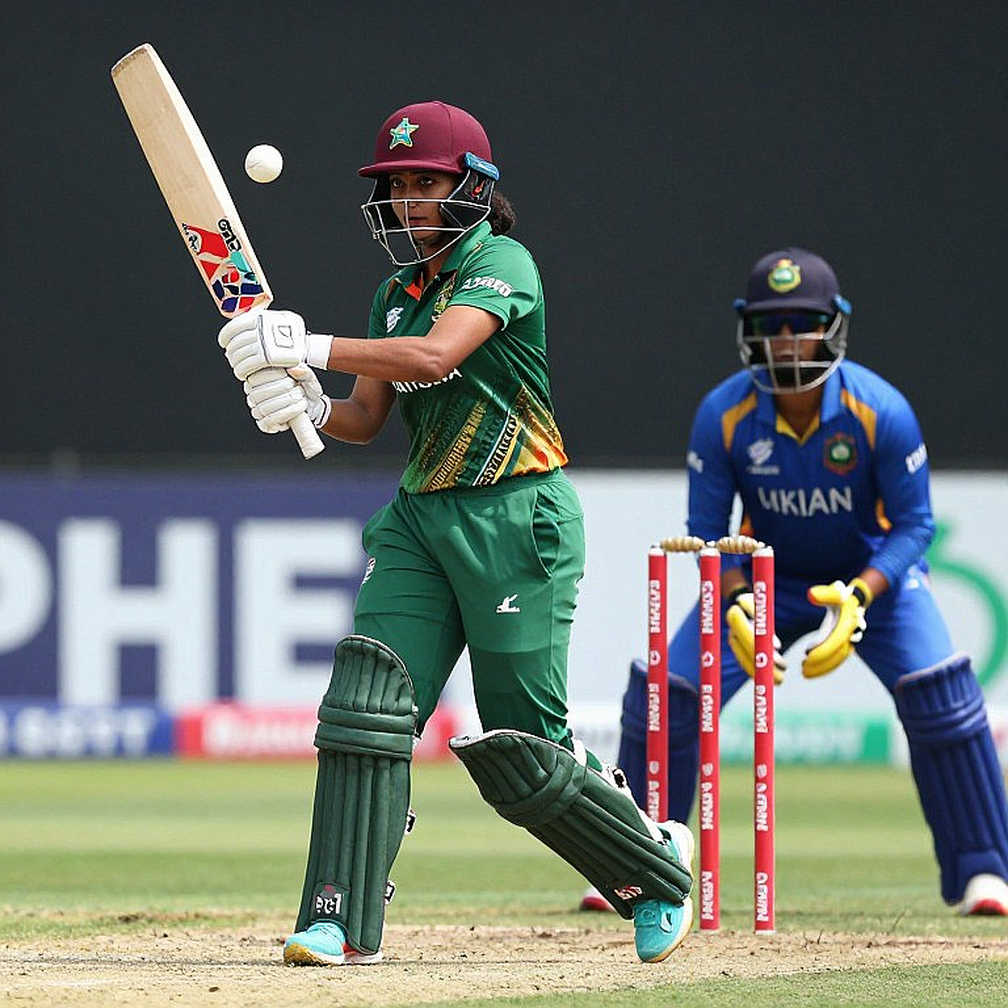
Rodrigues's cricketing identity
Her role in the team structure is clear. She is a right-handed middle-order batter whose value is measured principally by scoring speed under pressure rather than by volume of runs. In T20 that is the decisive parameter, and it is the axis on which her contribution is most debated.
This item supplies none of the material for that debate. There is no over-by-over detail, no split against pace and spin, no home-versus-away comparison, no recent-form indicator. Any number inserted here would be an estimate, and is therefore deliberately omitted.

The limitation is itself an observation. In this item Rodrigues is presented as a personality, not as a cricketer. Her sporting identity is used only as a reference to a past memory; not one sentence addresses current capability or current role. The pattern is familiar in Indian women's cricket coverage: a young player's public profile is built on brand and likability rather than on statistical dominance.
No blame attaches to the player. The question belongs to the journalism: who is giving a personal update the status of a sports headline, on what basis, and with what evidence standing behind it.
The curiosity-gap construction
The headline uses a well-known technique: open a gap and leave it open. 'Big life update', 'can't wait', and a summary that specifies nothing — the three elements form a complete pattern. The reader clicks because they want to know what the update is. Inside the article it is nowhere.
This is not editorial judgement but click optimisation. The difference looks small and is not: editorial judgement asks whether the reader needs to know; click optimisation asks whether the reader will click. The second question appears to have decided this item.
There is also a structural device — a double peg. An anniversary supplies nostalgia; a life update supplies novelty. Two different reader motivations are captured in a single item. That is efficient marketing, not journalism, and the distinction should be held firmly.
Verification failure
The quality of a news item depends on its sourcing chain. Here the chain is absent: no source, no date, no direct quotation except four words, no independent description of any event. The summary repeats the headline, meaning the summarisation stage added nothing new.
This is the signature of filler-grade production. When a scheduled publishing slot must be filled but no genuine event is available, items of this kind are produced: cheaply, from a single social media post, with tension added at the headline layer.
The phrase 'life update' conventionally denotes a personal milestone — relationship, family, lifestyle — and is almost never used for a cricketing development. The withholding in the headline may reflect that. It remains an inference, because the item confirms nothing.
The media economy of women's cricket
The real analytical value of this item lies here. It shows how attention in women's cricket is currently converted into value — through personality and nostalgia rather than through performance data.
Analysing what happened in a match costs labour: data collection, video review, comparison, interviews. Commemorating an anniversary costs almost nothing: one remembered date and one archived clip. Production cost approaches zero, and the immediate traffic return is comparatively reliable.
That imbalance has a long-run consequence. Audiences recruited by personality content do not automatically convert into match audiences — and broadcast rights and franchise valuations ultimately rest on match audiences. Short-term traffic can be won; long-term product depth is damaged.
An asymmetry is visible in miniature: the anniversary of one batter's innings draws more coverage than any structural question about India's middle order or their bowling at the death. The centre of coverage is the individual, not the team; the story, not the system.
WPL and the brand market
In the women's franchise market, Indian international batters hold a structural advantage: domestic-player quota logic means their demand reflects scarcity as well as output. Their market price reflects a supply constraint alongside marketability.
This item is a small sample of that economy. The capital being mobilised is the player's brand, decoupled from current form. No form data appears — and that is precisely the point. Brand coverage does not require performance; it requires recognition.
That structure favours the top tier of players and widens the gap for the rest. Those whose names are already known attract attention without a performance trigger; those whose names are not yet known find a narrower door.
Athlete privacy and consent
No regulatory violation is alleged here, and inventing one would be wrong. Neither ICC nor BCCI rules are engaged by the text. The risk is editorial, not regulatory.
What raises the question is the manner of publication: a personal 'life update' reported without source, date, link, or any statement of its content. That produces an incomplete picture for the reader and an unnecessary centre of curiosity around the player — particularly when the player is young and female.
A structural shift has occurred in modern sports media: players' own channels now function as a parallel news wire. There is no formal protocol — at ICC or board level — governing how that content is re-reported. Athlete privacy protection therefore depends on individual outlets' discretion. That is a vacuum, and this item sits inside it.
A caveat is essential: no privacy breach is being claimed. What happened is that a personal matter was placed in a news format with insufficient context and insufficient verification.
Risk map
Sporting risk here is negligible. No match, squad or result is affected. The risk divides into three.
First, informational risk. A reader who finishes the article knows not one sentence more about the innings being commemorated. The per-item impact is small; cumulative impact across many such items is not.
Second, attention asymmetry. If personality and anniversary items outnumber analytical items in women's cricket coverage, the audience's mental model of the game is built on personalities rather than on the sport — with downstream commercial consequences at broadcast-renewal time.
Third, product-depth risk. If cheap content is produced in volume, the incentive to produce expensive content declines. Over time the supply of analysis-capable journalism contracts.
Equally, it must be said plainly: this source contains no injury signal, no workload signal, no fixing signal and no financial-risk signal. Reporting them as present would be fabrication. The correct output is a null.
Expectation versus substance
The intensity in the headline is manufactured, not organic. 'Famous', 'big', 'can't wait' — the language is generated at the headline layer and is not corroborated by any fact in the body.
That creates an expectation gap, and the gap is adverse. If the update turns out to be minor, the credibility cost falls on the outlet; if it is major, the largest coverage will be captured by faster, better-sourced outlets. Either way the item's informational half-life is measured in days.
No transfer or auction rumour is present, so no leak-motive analysis applies. And where no source is named, no source-grading exercise is possible.
Industry transmission: upstream-driven, downstream-thin
Value originates upstream, in the player's own disclosure and the national-team pipeline. Midstream, it is aggregated and dropped into the attention pool for women's cricket. Downstream it travels three routes: personal brand and endorsements; franchise marketability; and the women's-game audience base.
The first two flows are small but positive. The third is very weak. Personality content recruits attention without building durable interest in the sport. On broadcast, franchise and audience-development channels, the impact of this item is close to nil.
Here the growth bottleneck of women's cricket is visible in miniature: the cheapest content to produce is also the least able to build the analytical audience on which rights values depend.
Conclusion
This is a zero-substance celebrity item resting on a curiosity-gap headline. An undisclosed 'life update' from an Indian women's-team batter has been fused with the anniversary of a celebrated World Cup innings against Australia to manufacture attention in a non-playing window. Its cricket value is effectively nil. Its analytical value is only as evidence of how women's-cricket attention is currently monetised — through personality and nostalgia rather than performance data, and with no verifiable sourcing at all.
What it does not say is more instructive still: which innings, which match, which format, which result. A reader wanting the substance of the 'famous' innings must go elsewhere. For a news item, that is not a normal condition; it is a failure.
It should not be read as an isolated case. If the proportion of such items rises in women's-cricket coverage, two questions follow. Who is writing the story of women's cricket — the person or the sport? And the audience being built now — why would it come back to the ground?
Neither answer has been written yet. This item does not help write them. It does, at least, make both questions visible — and that is probably its only real contribution.